
🌳 Ep. 221: Captain James Cook – Top 5 Facts Memory Mnemonic
👋 Intro
Hello and welcome to this episode of the podcast, "The Mnemonic Memory", where we add a single mnemonic leaf to our Tree of Knowledge.
I’m Jans, your Mnemonic Man, and today's episode will be on one of the most influential explorers in history, Captain James Cook.
Just before I get into the podcast, it is worth noting a few key dates in regard to Captain Cook. Firstly, January 17 is the 250th anniversary of Captain Cook becoming the first European to cross south of the Antarctic Circle. Secondly, January 26 is Australia Day, which is the date the convicts disembarked at Sydney Cove in 1788, but the arrival at Botany Bay was on January 18; however, this site was found to be unsuitable, hence Sydney Cove.
Born in 1728 in Yorkshire, England, Cook grew up in a modest farming family. After five years of schooling, Cook began work with his father, who was promoted to farm manager. He then worked in a shop as an apprentice when he was 16, which combined both a grocery and a haberdashery. Lack of interest led to him being introduced to local shipowners who took him on as a merchant navy apprentice.
He showed great promise and moved up the ranks swiftly; however, a recruitment drive by the Royal Navy lured him away, and he joined as a seaman. Around 13 years later, he was the commander of his first voyage on the HMS Endeavour to observe the transit of Venus across the sun from the island of Tahiti.
His second voyage was commissioned by the British government, which was to circumnavigate the globe as far south as possible to determine whether there was a great southern landmass. While his third and final voyage was to find the elusive Northwest Passage between the Pacific and Atlantic Oceans. This evaded him, and on his return journey, he met his unfortunate demise, being killed by indigenous people in Hawaii.
Cook’s story is one of self-education and discipline that led to him becoming highly proficient and talented in the fields of navigation, astronomy, and cartography, which vastly expanded colonial influence.
Today’s mnemonic will be on Captain James Cook’s top five facts.
So, with that being said, we will begin with a summary from Wikipedia.
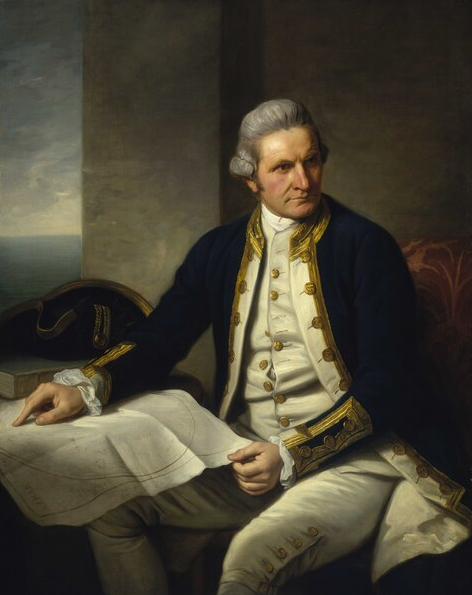
📖 Wikipedia Summary
Captain James Cook (7 November 1728[a] – 14 February 1779) was a British Royal Navy officer, explorer, and cartographer who led three voyages of exploration to the Pacific and Southern Oceans between 1768 and 1779. He completed the first recorded circumnavigation of the main islands of New Zealand, and led the first recorded visit by Europeans to the east coast of Australia and the Hawaiian Islands.
Cook joined the British merchant navy as a teenager before enlisting in the Royal Navy in 1755. He first saw combat during the Seven Years' War, when he fought in the Siege of Louisbourg. Later in the war he surveyed and mapped much of the entrance to the St. Lawrence River during the Siege of Quebec.
In the 1760s he mapped the coastline of Newfoundland and made important astronomical observations which brought him to the attention of the Admiralty and the Royal Society. This acclaim came at a pivotal moment in British overseas exploration, and it led to his commission in 1768 as commander of HMS Endeavour for the first of his three voyages.
During these voyages he sailed tens of thousands of miles across largely uncharted areas, mapping coastlines, islands, and features across the globe in greater detail than previously charted – including Easter Island, Alaska, and South Georgia Island. He made contact with numerous indigenous peoples, and claimed several territories for the Kingdom of Great Britain.
Renowned for exceptional seamanship and courage in times of danger, he was patient, persistent, sober, and competent, but sometimes hot-tempered. His contributions to the prevention of scurvy, a disease common among sailors, led the Royal Society to award him the Copley Gold Medal.
In 1779, during his second visit to Hawaii, Cook was killed when a dispute with Native Hawaiians turned violent. His voyages left a legacy of scientific and geographical knowledge that influenced his successors well into the 20th century. Numerous memorials have been dedicated to him worldwide.
Extracted from: [https://en.wikipedia.org/wiki/James_Cook]
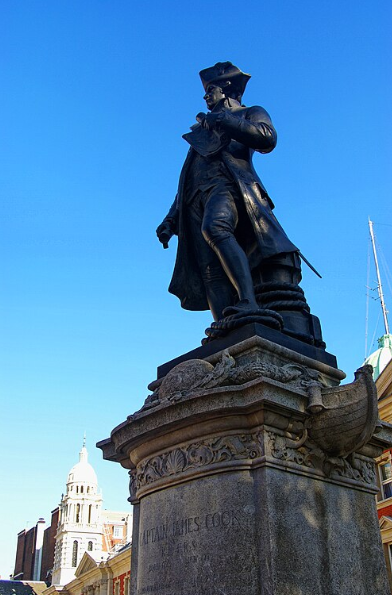
🧠 Memory Mnemonic
Captain James Cook – Top 5 Facts Memory Mnemonic – BuFFFY
(Picture Captain Cook having his own Buffy on board to slay vampires, demons, and other supernatural threats on his voyages.)
1. Born in Yorkshire, England, in 1728
2. First recorded circumnavigation of New Zealand
3. First recorded visit by Europeans to the east coast of Australia and the Hawaiian Islands
4. First to cross the Antarctic Circle
5. Year of 1779, Cook was killed by Hawaiians
🔎 Five Fun Facts
1. Cook worked on a Yorkshire farm in his youth before winning an apprenticeship with a merchant sailing company at age 17. From here, he rose through the ranks and focused on mastering the art of navigation. He was well on his way to becoming captain but shocked his superiors when he enlisted in the British Royal Navy, where he later became one of the first men in British naval history to rise through the enlisted ranks and take command of his own vessel.
2. Cook was held in high esteem for his map-making. One example was during the Seven Years’ War, where his detailed charts of the Saint Lawrence River helped the British pull off a surprise attack against French-held Quebec. This expertise in producing precise maps helped him win command of his first round-the-world voyage in 1768.
3. Cook’s first voyage was ostensibly a scientific expedition that entailed sailing to Tahiti to observe the transit of Venus across the face of the sun in order to help scientists better calculate the distance between the Earth and the Sun. But there was a hidden agenda. He carried sealed orders instructing him to seek out the “Great Southern Continent,” an undiscovered landmass that was believed to exist somewhere near the bottom of the globe. Cook sailed to the 40th parallel but found no evidence of this southern continent.
4. One of Cook’s greatest challenges came when his ship, the Endeavour, was nearly sunk on the Australian Great Barrier Reef in 1770. This occurred when Cook was heading to the Dutch Seaport of Batavia after landing in Australia. As these waters were uncharted, he sailed directly over the razor-sharp coral formations of the Great Barrier Reef. After more than 20 hours of frantic work by the crew, he made it to shore to conduct repairs that would take approximately two months.
5. In the 18th century, long-distance sea voyages were plagued with scurvy, which is a disease caused by a lack of vitamin C. Cook helped pioneer new methods to mitigate this disease; some by luck and others by keen observance. Cook’s formulae was for fresh food at each of his stops, citrus, and sauerkraut, which he smartly encouraged sailors to eat when it was placed on the officers’ table each day.


🎓 Three-Question Quiz
Q.1. What was the name of Captain Cook’s famous ship on his first voyage?
Q.2. Which came first? The circumnavigation of New Zealand or charting the east coast of Australia.
Q.3. What name did Cook give to the Hawaiian Islands?
Bonus Q. What was the name of the Hawaiian bay where Captain Cook was killed?
Bonus Q. What did the explorer say when he spotted Antarctica?
🧠 Memory Mnemonic Recap
Captain James Cook – Top 5 Facts Memory Mnemonic – BuFFFY
(Picture Captain Cook having his own Buffy on board to slay vampires, demons, and other supernatural threats on his voyages.)
1. Born in Yorkshire, England, in 1728
2. First recorded circumnavigation of New Zealand
3. First recorded visit by Europeans to the east coast of Australia and the Hawaiian Islands
4. First to cross the Antarctic Circle
5. Year of 1779, Cook was killed by Hawaiians
🎓 Three-Question Quiz Answers
Q.1. What was the name of Captain Cook’s famous ship on his first voyage?
A. The HMS Endeavour
Q.2. Which came first? The circumnavigation of New Zealand or charting the east coast of Australia.
A. The circumnavigation of New Zealand in 1769. The east coast of Australia was discovered in 1770.
Q.3. What name did Cook give to the Hawaiian Islands?
A. The Sandwich Islands
Bonus Q. What was the name of the Hawaiian bay where Captain Cook was killed?
A. Kealakekua Bay
Bonus Q. What did the explorer say when he spotted Antarctica?
A. I see land!
🔤 Word of the Week
Panglossian
characterized by or given to extreme optimism, especially in the face of unrelieved hardship or adversity.
Example
Captain James Cook’s Panglossian faith in science and navigation led him to believe that careful measurement, reason, and discipline could overcome any danger the unknown Pacific might present.
Extracted from: [https://www.dictionary.com/]
💡 Memory Tip
For our memory tip today, we will be talking about Spaced Repetition. Spaced repetition is not a mnemonic itself but a method of practice to review information at increasing intervals to strengthen long-term retention.
Rather than cramming information at the last moment, which is likely to be forgotten, spaced repetition revisits the material before it is likely to be forgotten.
This method is based on the forgetting curve, which is unique to each individual and is widely used in flashcard systems, language learning, and exam preparation. This practice makes the learning process more efficient and significantly improves long-term retention. See you next week.
👉 Free Memory Mnemonics at:
https://www.themnemonictreepodcast.com
🎧 Listen on Apple Podcasts:
https://podcasts.apple.com/au/podcast/the-mnemonic-tree-podcast/id1591795132
🎧 Listen on Spotify:
https://open.spotify.com/show/3T0LdIJ9PBQMXM3cdKd42Q?si=fqmaN2TNS8qqc7jOEVa-Cw
🔗 References
https://chatgpt.com/c/695c478b-4264-8322-ad0d-b07ecdbc8bbd
https://www.visitwhitby.com/blog/captain-james-cook-facts/
PANGLOSSIAN Definition & Meaning | Dictionary.com
https://www.history.com/articles/10-things-you-may-not-know-about-captain-james-cook
https://kids.kiddle.co/James_Cook
https://www.factinate.com/people/astonishing-facts-captain-james-cook