🌳 Ep. 219: Saint Nicholas – Top 5 Facts Memory Mnemonic
👋 Intro
Hello and welcome to this episode of the podcast, "The Mnemonic Memory", where we add a single mnemonic leaf to our Tree of Knowledge.
I’m Jans, your Mnemonic Man, and today's Christmas episode will be on the real Mr Santa Claus himself, the OG, the altruistic, the magnanimous, Saint Nicholas.
Saint Nicholas of Myra was a 4th-century Christian bishop whose life inspired the ubiquitous figure of Santa Claus. He was born around 270 A.D. in Patara, in the Roman province of Lycia, which is modern-day Turkey. He came from a wealthy Christian family to which he inherited a large fortune.
This is where the story begins. He chose to give away his fortune in secret to help the sick and the poor. His compassion and humility earned him great respect amongst Christians, along with his defence of Christian beliefs at a time of persecution.
Saint Nicholas has many stories of generosity, but probably his most famous is where he
secretly gave gold to a poor father so his daughters could marry, rather than be sold into slavery.
In light of his boundless generosity, Saint Nicholas was established as the patron saint of children, sailors, travellers, merchants, the poor, and many more. After his death, his legend grew, and devotion to him spread rapidly throughout Europe. On the day of his death, December 6th became his feast day and was associated with gift-giving and kindness.
Over the centuries, his image has evolved to a fat, portly, happy man now known as Santa Claus, but the generosity, gift giving, and kindness remain, and continues to shine a light on Saint Nicholas’s humility and compassion and amazing deeds of giving and generosity.
Today’s mnemonic will be on the top five facts about Saint Nicholas.
So, with that being said, we will begin with a summary from Wikipedia.
📖 Wikipedia Summary
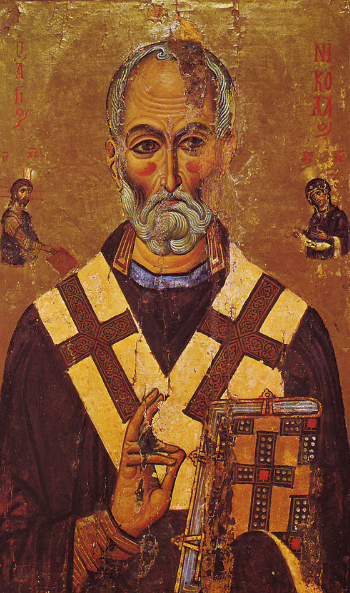
Saint Nicholas of Myra[a] (traditionally 15 March 270 – 6 December 343),[3][4][b] also known as Nicholas of Bari, was an early Christian bishop of Greek descent from the maritime city of Patara in Anatolia (in modern-day Antalya Province, Turkey) during the time of the Roman Empire.[7][8]
Because of the many miracles attributed to his intercession, he is also known as Nicholas the Wonderworker.[c] Saint Nicholas is the patron saint of sailors, merchants, archers, repentant thieves, children, brewers, pawnbrokers, toymakers, unmarried people, and students in various cities and countries around Europe.
His reputation evolved among the pious, as was common for early Christian saints, and his legendary habit of secret gift-giving gave rise to the folklore of Santa Claus ("Saint Nick") through Sinterklaas.
Little is known about the historical Saint Nicholas. The earliest accounts of his life were written centuries after his death and probably contain legendary elaborations. He is said to have been born in the Anatolian seaport of Patara, Lycia, in Asia Minor to wealthy Christian parents.[9]
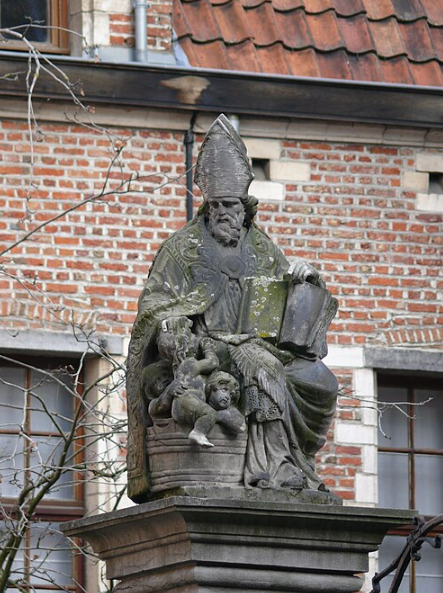
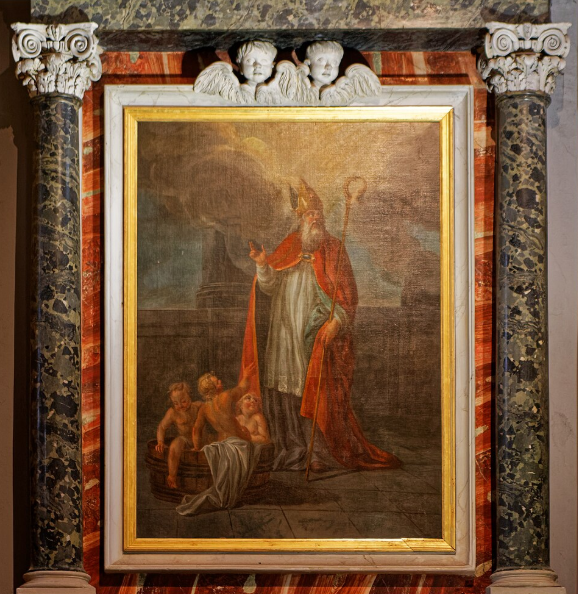
In one of the earliest attested and most famous incidents from his life, he is said to have rescued three girls from being forced into prostitution by dropping a sack of gold coins through the window of their house each night for three nights so their father could pay a dowry for each of them.[10]
Other early stories tell of him calming a storm at sea, saving three innocent soldiers from wrongful execution, and chopping down a tree possessed by a demon. In his youth, he is said to have made a pilgrimage to Egypt and Syria Palaestina. Shortly after his return, he became Bishop of Myra. He was later cast into prison during the persecution of Diocletian, but was released after the accession of Constantine.
Fewer than 200 years after Nicholas's death, the St. Nicholas Church was built in Myra under the orders of Theodosius II over the site of the church where he had served as bishop, and his remains were moved to a sarcophagus in that church.
Extracted from: [https://en.wikipedia.org/wiki/Saint_Nicholas]
🧠 Memory Mnemonic
Saint Nicholas – Top 5 Facts Memory Mnemonic – BeWaFTeD
(Picture Saint Nicholas who was bewafted (carried or conveyed, especially by wind or waves)
to deliver all his gifts secretly)
1. Born in Patara in Anatolia 270 A.D.
2. Was Bishop of Myra
3. Feast Day celebrates Saint Nicholas
4. The Dutch called him Sinterklaas
5. Died 343 A.D.
🔎 Five Fun Facts
1. Saint Nicholas’s name of Nicholas, is of Greek origin and means “victor of people.” He was born in Patara in 270 A.D. and served as Bishop of Myra, where he lived all his life. His parents died after he was born, contracting a disease whilst feeding the sick.
2. Saint Nicholas was known for giving gifts anonymously, which raises the question of how we ever knew it was him! But he believed that charity was more meaningful when done in secret, without the praise or recognition, and this is what strongly influenced the later traditions of surprise gift-giving, which started on the anniversary of his death on December 6th.
3. Saint Nicholas was eventually bestowed the name of Santa Claus thanks to the Dutch. The Dutch initially shortened Saint Nicholas’s name to Sinterklaas and brought this name and tradition to North America in 1621, when they founded New Amsterdam on the tip of Manhattan. The name then gradually evolved from Sinterklaas to Santa Claus thanks to English settlers.
4. Many food traditions have also originated from Saint Nicholas. Firstly, oranges were a popular treat as a stocking filler in Holland and North America. The oranges recall the three round purses containing gold coins Saint Nicholas threw into the window of the destitute family on those three consecutive nights to save the three daughters from prostitution. While the candy canes, which have become a staple in America, are derived from Saint Nicholas’s Bishop’s staff.
5. Saint Nicholas’s bones have done more traveling in his death than when he was alive! Saint Nicholas was initially buried in his hometown of Myra. Around 200 years later, the St. Nicholas Church was built in Myra over his tomb. His remains were moved to a sarcophagus in that church. But with the threat of subjugation, a group of merchants from the Italian city of Bari removed the major bones of Nicholas's skeleton from his sarcophagus in the church and brought them to their hometown, where they are now enshrined in the Basilica di San Nicola. While the remaining bone fragments from the sarcophagus were later removed by Venetian sailors and taken to Venice during the First Crusade.


🎓 Three-Question Quiz
Q.1. In which modern-day country was Saint Nicholas born?
Q.2. What role did Saint Nicholas hold in the Christian Church?
Q.3. Did Saint Nicholas save the lives of three men falsely condemned to be executed by a corrupt magistrate who accepted a bribe? Is that True or False
Bonus Q. On what date is Saint Nicholas’s feast day celebrated?
Bonus Q. What do you call a broke Santa Claus?
🧠 Memory Mnemonic Recap
Saint Nicholas – Top 5 Facts Memory Mnemonic – BeWaFTeD
(Picture Saint Nicholas was bewafted (carried or conveyed, especially by wind or waves)
to deliver all his gifts secretly)
Born in Patara in Anatolia, 270 A.D.
Was Bishop of Myra
Feast Day celebrates Saint Nicholas
The Dutch called him Sinterklaas
Died 343 A.D.
🎓 Three-Question Quiz Answers
Q.1. In which modern-day country was Saint Nicholas born?
A. Turkey. Patara, in the Roman province of Lycia
Q.2. What role did Saint Nicholas hold in the Christian Church?
A. Bishop of Myra
Q.3. Did Saint Nicholas save the lives of three men falsely condemned to be executed by a corrupt magistrate who accepted a bribe? Is that True or False
A. True. He got there just in time and grabbed the sword and threw it to the ground and freed the men, after which he shamed the magistrate for accepting the bribe
Bonus Q. On what date is Saint Nicholas’s feast day celebrated?
A. December 6
Bonus Q. What do you call a broke Santa Claus?
A. Saint "Nickel"-less, and for all those kids out there who want to know when Santa is coming around; I’m sure you’ll be able to sense his presents!
🔤 Word of the Week
subfusc
adjective
subfuscous; dusky.
dark and dull; dingy; drab.
Example
Saint Nicholas is often depicted in subfusc tones, reflecting the austere humility of his early bishop’s robes, rather than the Coca-Cola Santa of today.
Extracted from: [https://www.dictionary.com/]
💡 Memory Tip
For our memory tip today, we will be talking about Method Acting. It is not a mnemonic but I do have a mnemonic for it, which I found in my research, that I thought was worth sharing.
Method acting is a performance approach in which actors deeply embody their characters by drawing on personal memories, emotions, and sensory experiences. Developed in the early twentieth century and influenced by Konstantin Stanislavski, it was later refined by teachers such as Lee Strasberg. Actors that are commonly associated with Method Acting include: Marlon Brando, James Dean, Al Pacino, and Daniel Day-Lewis.
The Mnemonic for Method Acting is “METHOD”
Memory – recall a similar life moment
Emotion – feel what the character feels
Truth – act honestly, not theatrically
Habits – copy the character’s gestures
Observation – study real people
Devotion – stay committed to the role
See you next week.
👉 Free Memory Mnemonics at:
https://www.themnemonictreepodcast.com
🎧 Listen on Apple Podcasts:
https://podcasts.apple.com/au/podcast/the-mnemonic-tree-podcast/id1591795132
🎧 Listen on Spotify:
https://open.spotify.com/show/3T0LdIJ9PBQMXM3cdKd42Q?si=fqmaN2TNS8qqc7jOEVa-Cw
🔗 References
https://chatgpt.com/c/694098c3-0738-8324-bf62-0b93c10b2daf
https://www.ncregister.com/blog/19-little-remembered-facts-about-st-nicholas
https://www.ebooks4ukrkids.org/facts-about-saint-nicholas-day/